Kathy Temin’s Eccentric Abstraction
4 Dec 2025
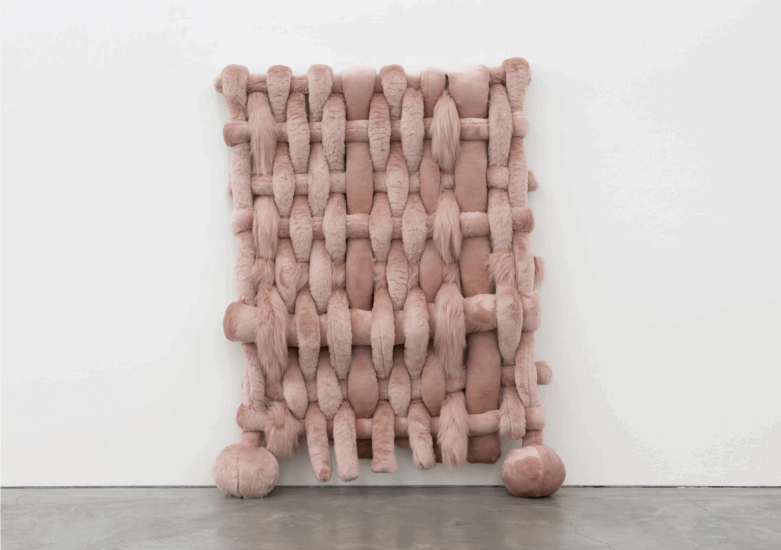
Kathy Temin came to prominence in the 1990s with works that hover between painting and sculpture, art and craft, abstraction and figuration. Her signature medium of synthetic fur provides contrasting environments of soft material against geometric form. Within these monochromatic spaces, references to absence and cultural displacement of her family history unfold. Her sculptures become memorial sites for loss and remembrance for both the personal and the collective. The sensory nature of her tactile practice provides a comforting place for respite and reflection within this narrative.
We ask the artist more about how she creates her emotionally resonant and playful works.
What made you first decide to use synthetic fur in your work?
When I was in art school in the 1990s, I was interested in the heightened emotional content of soft toy imagery — its reference to comfort and protection, and its challenge to dominant ideas of taste. The synthetic fur, with its bodily reference, has continued to help me explore my interest in anthropomorphism without a direct representation of the body and convey an emotional world without illustrating it.
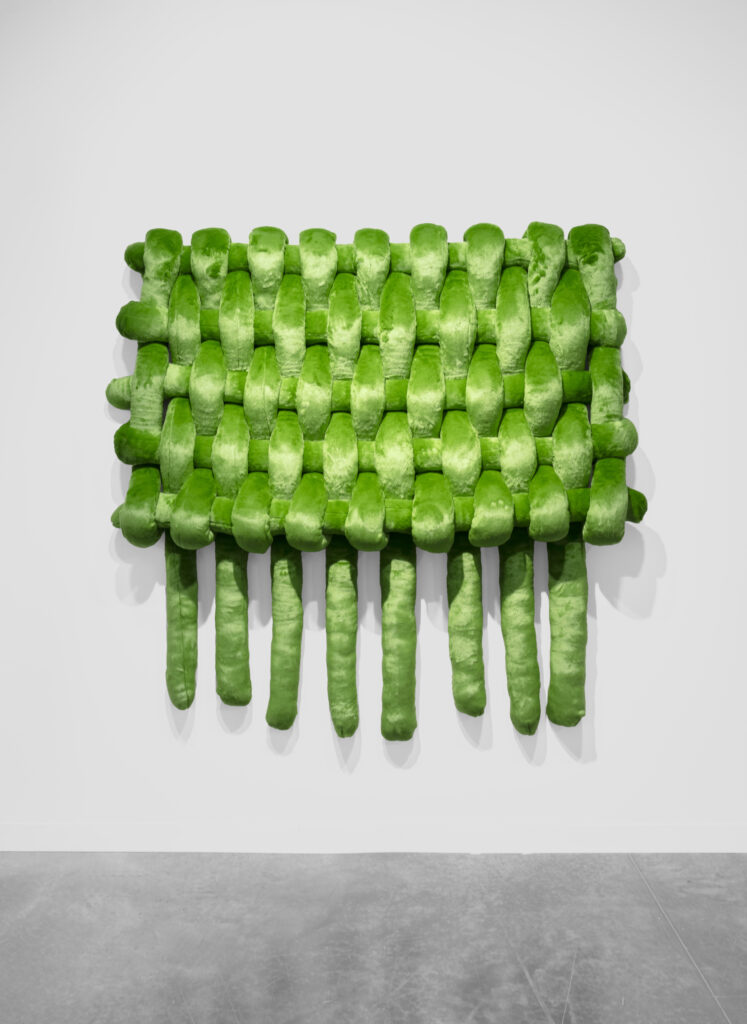
Kathy Temin, Woven: Green (Large), 2025, Synthetic fur, synthetic filling and wood, 180 x 180 x 20 cm
How does your work address ideas of trauma and memory?
As the daughter of a Jewish-Hungarian Holocaust survivor who migrated to Australia, I grew up with no family on my father’s side. No one in my family talked about this experience and my father passed away before I could talk to him about it. This is the fundamental intergenerational trauma of absence that I live with. My presence in the world is about honoring my father’s survival, alongside a collective memory of global traumas.
As an artist, I explore material and popular cultures, that include 1970s interior design and architecture, to make sense of the world. My work oscillates between private and collective remembrance and childhood memories anchored by particular colours, smells, songs or clothing. Over long periods, working with my hands repetitively on a very large scale, I work through these ideas. This way of working asks you to be present in the moment and is a way of marking memory. I have a strong alliance with minimalism, especially where emotion and repetition come together, drawing from other artists like Eva Hesse.
How do you achieve the playful tension that runs through all of your work?
I’m interested in texture, form and sensory dialogues. Play and experimentation start the process with all my work. I genuinely get excited when I come across materials, or when I have synthetic fur made for me, in particular colours, as with the dusty pink and the green of my recent works. I sometimes buy clothes not to wear them, simply because of their material.
I usually combine these soft materials, that refers to play, dress-up, drag, interior design, with oppositional ideas. I was drawn to Lucy Lippard’s 1970s concept of ‘eccentric abstraction’ and have these ideas in dialogue to explore unknown outcomes. For example, I combine remembrance with play, and minimalism with sentimentality. I like not knowing what I’m looking at and trying to make sense of things. The longer you look, the more it un-forms.
Ames Yavuz is pleased to present works by Kathy Temin at Art Basel Miami Beach 2025.