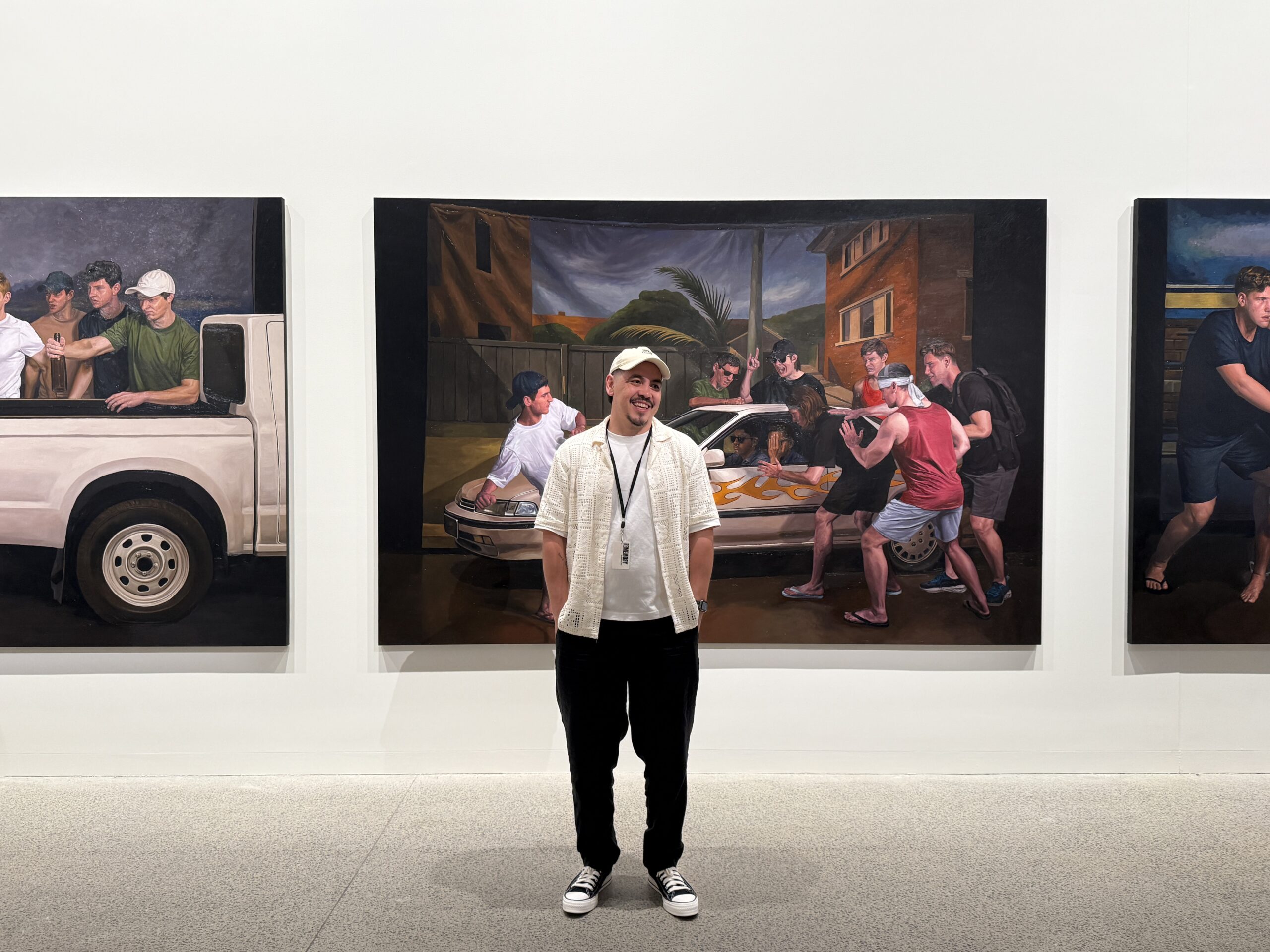
Abdul Abdullah at The 25th Biennale of Sydney
12 Mar 2026
Abdul Abdullah’s presentation at the 25th Biennale of Sydney ‘Rememory’ curated by Hoor Al Qasimi features a triptych depicting three moments from the 2005 Cronulla riots. More than 20 years since the event in which over 5000 people gathered at Cronulla, a suburb in Southern Sydney, to ‘reclaim the beach from [non-white] outsiders’, the riots remain relevant in Australia’s political subconscious.
Abdullah’s work restages the riots as Neoclassical historical paintings, made by reconstructing documentary photography in his studio with semi-professional actors, in turn the reference material for the paintings on view. Through the meticulous re-articulation and re-animation of details from the riots, the work retrieves the event from a sanitised past and repositions it within Australia’s national visual canon.
Ahead of the 25th Biennale of Sydney, we spoke to the artist about his work.
The triptych uses the Cronulla riots to explore communal violence and racism. What drew you to this historic event now?
“The new Cronulla works connect to broad themes in my practice, importantly the projection of monstrosity on benign bodies to justify the unjust seizure of land, bodies, labour and resources. The riots took place in the aftermath of the 9/11 attacks in the US in 2001 and the subsequent ‘War on Terror’ that overshadowed and defined an entire generation of Muslims. It also took place alongside the invasions of Afghanistan and Iraq. My research had me unpacking anti-colonial and anti-imperial movements through the 20th century. I read that the first ever slave revolt in Haiti was reported at the time as a ‘Jihad’. I unpacked ‘The white man’s burden’ and came to understand how the enterprising, entrepreneurial and commercial nature of colonisation and empire was packaged as the moral obligation of the civilised.
I wanted to mark the 20-year anniversary of the riots by revisiting this period with hindsight. I wanted to recontextualise it in the violent events that have taken place in Australia and the world before and after it and bring it into the current vernacular. I removed specific markers such as flags and signs from my work, so that they can be also understood as depictions of conflict and violence at large.”
The works present three scenes from the 2005 riots against theatrical backdrops. What function does the gestures of staging and performance play in the work?
“The works present a theatrical retelling of history. I was inspired by works such as the Banquet of Cleopatra (1743-1744) by Giambattista Tiepolo at the National Gallery of Victoria, which presents a scene from the love affair between the Roman consul Mark Antony (83–30 BC) and the Egyptian queen, Cleopatra, as a dramatic tableau. Much like such Neoclassical works, I wanted to create settings for scenes from the riots as if in a play and keep all the contrivances of making this image within it. I wanted to signal that I am not simply painting ‘what happened’ but presenting a telling of the history. The political arena and its messaging are so often theatrical, that playing with perception in this way felt apt.
The works in series are quite literally tableaux, as they are based on staged photographs of models and semi-professional models posing in the studio. This is the first time that I have used staged photographs in this way, to create reference images. I looked at a lot of historical painting and documentary painting to direct and create the photographs, which became condensed narratives of the historic event”
You have returned to the 2005 riots many times in your career. What keeps you interested in telling its story?
“I keep touching on this moment in history in my work, such as the 2016 portrait of Craig Campbell, a police officer who saved the lives of two victims. But the previous works feel quite different as I haven’t pursued the type of ambition that drove this body of work. This is the first time that I have made work that feels important to Australia’s visual history. When I think about how we will remember the Cronulla riots in the future, I hope that this series becomes part of the event’s visual repertoire.”
The Biennale of Sydney runs from 14 March – 14 June 2026.
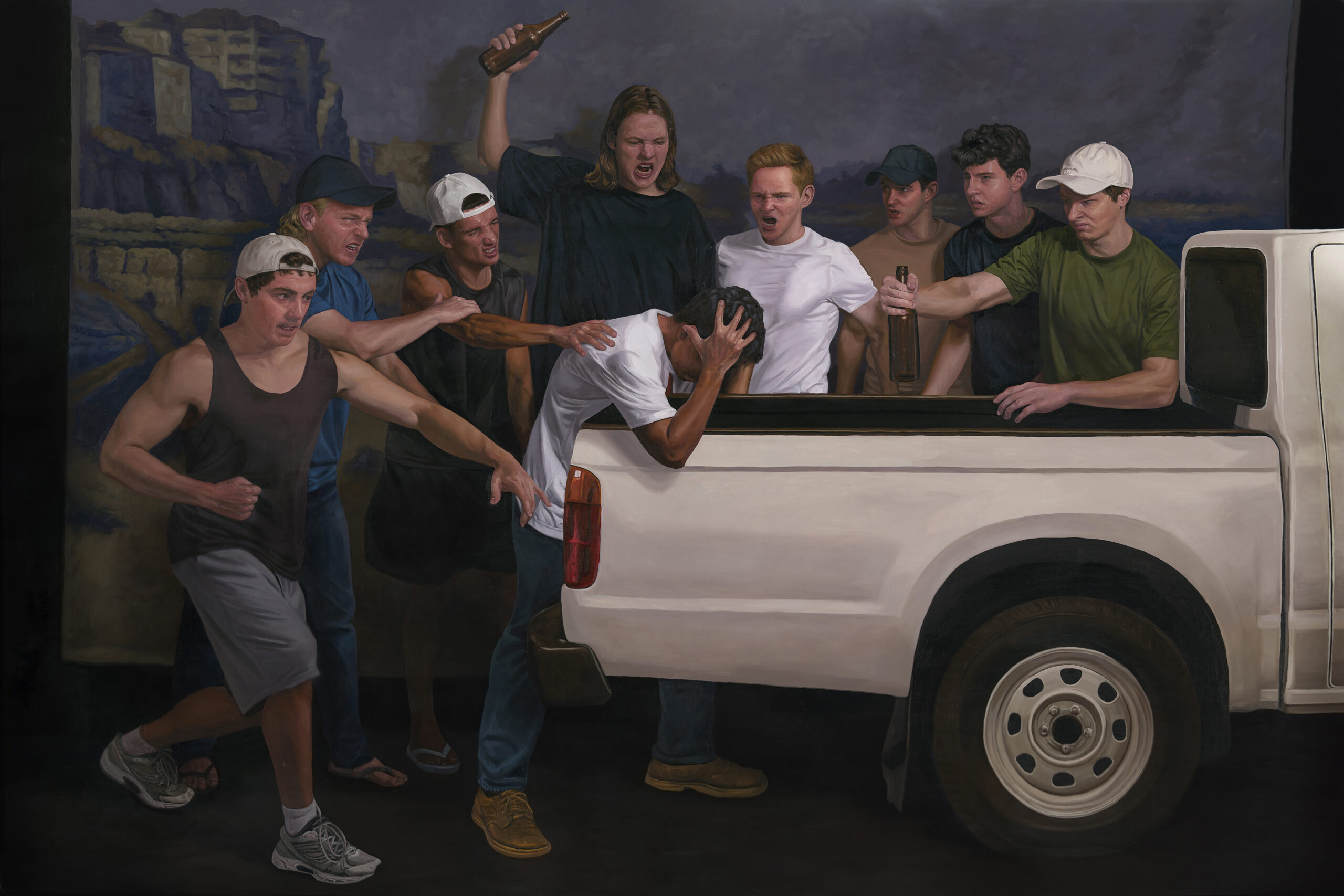
Abdul Abdullah, North Cronulla Beach Car Park approx 1 45pm, 2025, Oil on linen, 200 x 300 cm
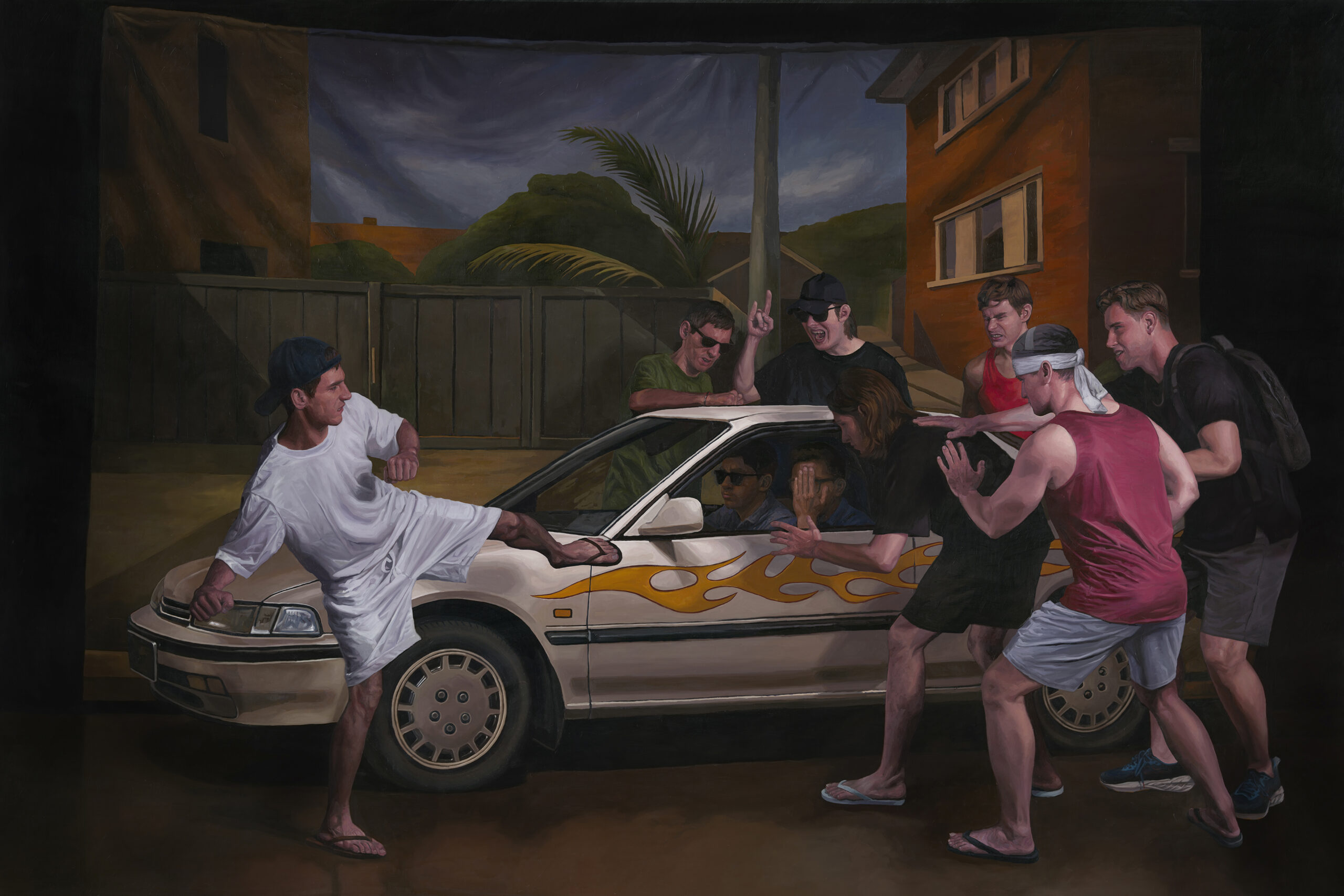
Abdul Abdullah, Mitchell Road approx 2 40pm, 2025, Oil on linen, 200 x 300 cm
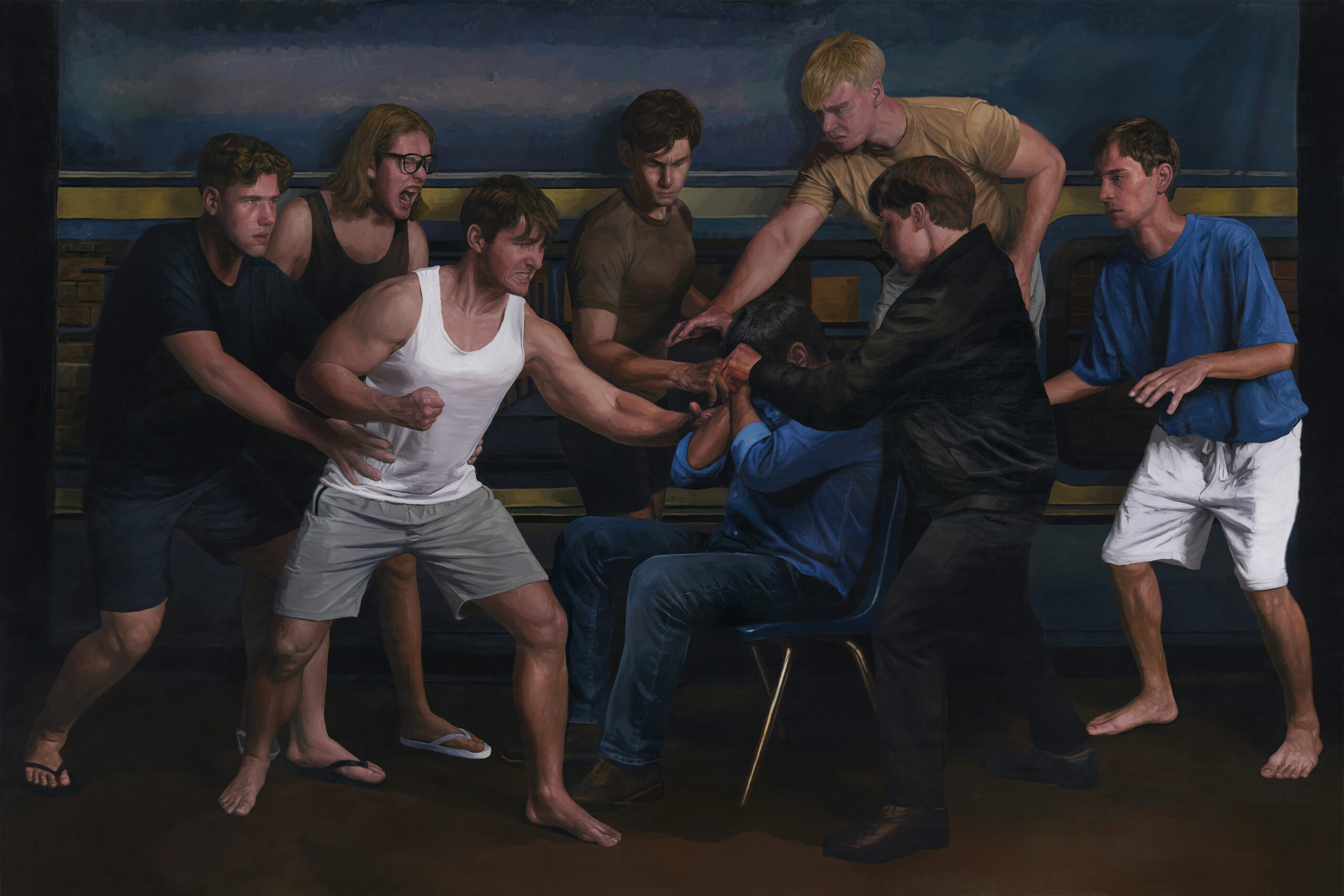
Abdul Abdullah, Cronulla Railway Station approx 3 00pm, 2025, Oil on linen, 200 x 300 cm